
TL;DR
- US tree planting is done mostly by private contractors. The Forest Service reforested 285,000 acres in fiscal 2025, its most in 25 years, and buys the planting through contracts.
- Published piece rates for the 2026–27 season run $30 to $35 per 1,000 trees in Mississippi and Alabama, and 3 cents a tree in Arkansas. Each job order also guarantees an hourly wage of about $16.55 to $24.82.
- Piece-rate pay must average at least minimum wage for every hour in each workweek. Overtime is half your average hourly rate for each hour over 40. In 2027 the state minimum is $17.73 in Washington and $17.40 in California.
- The Bureau of Labor Statistics put the median forest and conservation worker at $21.00 an hour ($43,680 a year) in May 2025.
- The season is winter and spring: December to mid-March in northwest Oregon, December to April in Washington, and April to June in the Northern Rockies. Two Oregon contractors posted their spring 2026 H-2B job orders in November and December 2025.
Tree planting is hard work that is easy to get: southern contractors hire people with no experience. You carry a bag of seedlings across burns and clearcuts, plant a tree every few steps, and get paid by the hour, by the tree or by the acre.
This guide covers the work, the piece-rate rules, the planting windows and who is hiring for spring 2027, using federal contract records, Labor Department job orders and state forestry agencies. Federal GS jobs like reforestation technician are a separate track; see Forest Service seasonal jobs.
What does a tree planter do all day?
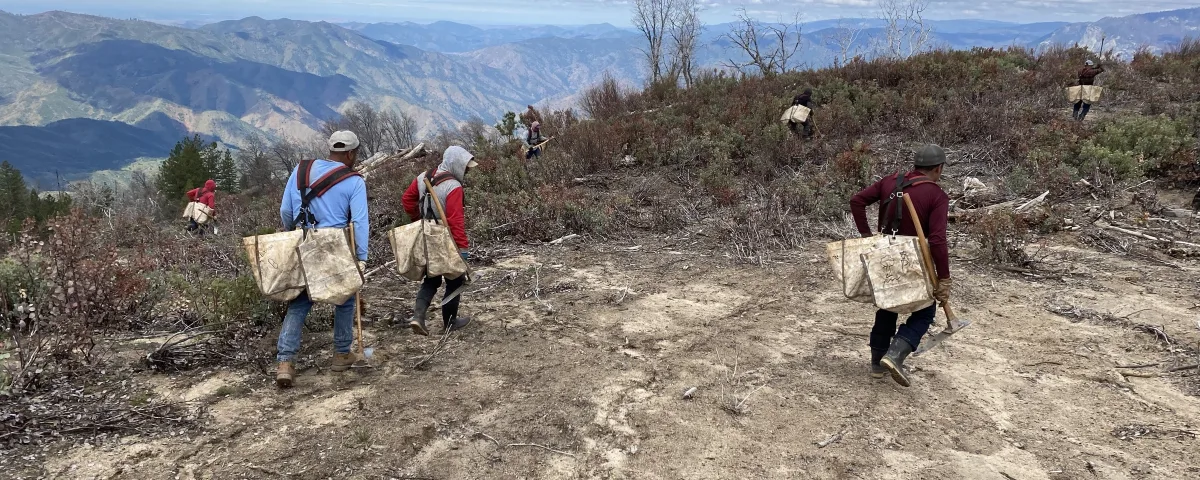
You plant 900 to 3,000 seedlings a day, depending on terrain. Planters wear a bag of seedlings, dig a hole with a shovel, hoedad or dibble bar, set the tree, close the hole and step to the next spot.
The pace depends on the ground. Labor Department job orders set daily production standards, usually after a week of training:
- Southern sites: 1,750 trees in a 7-hour day (Cornejo Forestry, Alabama), 2,000 in 8 hours (Amigo Forestry, Mississippi) and 3,000 in 8 hours (Mendiola Forestry, Arkansas).
- Western Oregon slopes: 900 to 1,300 trees a day on 30 to 70 percent slopes with bags of up to 50 pounds (Whitepine Forestry, spring 2026).
- Bag loads: 500 to 1,000 seedlings per bag (Green Mountain Forestry, Georgia); 50 to 60 pounds on 40 to 50 percent slopes (Southwest Forestry, Oregon).
Quality is checked, because the landowner pays for live trees. Oregon’s reforestation guide tells landowners to put inspectors with crews, reject J- and L-shaped roots, and set the root collar level with or slightly below the soil.
Spacing is set by the contract. Washington DNR recommends 10 to 12 feet between trees, and state rules require at least 190 trees per acre in western Washington. For Douglas-fir, Oregon’s guide suggests 350 to 400 trees per acre.
Both states say to carry no more seedlings than you can plant in one to two hours. Expect rain, frost, mud and long walks: job orders mention walks of up to 15 miles a day and hikes of up to 3 miles from the road.
How much do tree planters make per tree?
Published piece rates for the 2026–27 season run from 3 cents a tree to $100 per 1,000 trees. The only contractors that publish rates are the ones filing H-2B job orders with the Labor Department, so these figures come from those filings.
| Contractor (base) | Season | Piece rate | Hourly guarantee |
|---|---|---|---|
| Cornejo Forestry Service (Fayette, AL) | Oct 1, 2026 to Apr 29, 2027 | $33.00 per 1,000 seedlings | $20.59 |
| Reforestation Specialists (Braxton, MS) | Oct 1, 2026 to Apr 16, 2027 | $30.00 to $35.00 per 1,000 | $18.99 to $23.71 |
| Mendiola Forestry Services (Warren, AR) | Oct 1, 2026 to Jun 30, 2027 | $0.03 per tree | $18.99 to $21.13 |
| Amigo Forestry Service (Grenada, MS) | Oct 1, 2026 to Jun 30, 2027 | $20.00 to $100.00 per 1,000 hand-planted | $16.55 to $24.55 |
| Stan Sweeney, LLC (Hermitage, AR) | Oct 1, 2026 to Apr 15, 2027 | $13.00 to $57.00 per acre, 200 to 600 trees per acre | $18.99 to $21.13 |
Source: U.S. Department of Labor SeasonalJobs.dol.gov H-2B job orders posted July 2026. Under H-2B rules, if piece earnings fall short of the hourly wage in a workweek, the employer must make up the difference (20 CFR 655.20).
At these rates, the hourly wage usually wins. Cornejo’s standard of 1,750 trees at $33 per 1,000 is $57.75 for a 7-hour day, about $8.25 an hour, against a $20.59 guarantee. To beat it, you would need more than 620 trees an hour.
For comparison, the Forest Service paid Ponderosa Timberland $0.50 per seedling to plant 344,430 trees in Oregon’s Gales and Cedar Creek burns in 2025. That price covers the contractor’s whole cost, not only the planters’ wages.
The Bureau of Labor Statistics counts 6,050 forest and conservation workers (occupation 45-4011). Their median was $21.00 an hour, or $43,680 a year, in May 2025. The 10th percentile was $16.24 and the 90th was $27.51.
That survey leans public. Of those 6,050 workers, 2,880 work for state government and 1,000 for local government. State medians were $21.36 in Washington, $22.12 in Oregon, $21.00 in California and $28.59 in Idaho.
Does piece-rate pay have to meet minimum wage?
Yes, averaged across each workweek. The Labor Department’s reforestation fact sheet says federal minimum wage and overtime rules apply “even if an employee is paid on a piece rate.” The workweek is the unit of measure (29 CFR 776.4), so the check is made week by week.
Here is how it works. Divide the week’s piece earnings by the hours you worked. If that average is below the minimum wage, the employer must top it up. The floor is the highest one that applies: federal, state or, on an H-2B job order, the offered wage.
| Where you plant | Minimum wage | In effect |
|---|---|---|
| Washington | $17.73 | From Jan 1, 2027 ($17.13 in 2026) |
| California | $17.40 | From Jan 1, 2027 |
| Oregon | $15.55 standard, $14.55 nonurban counties, $16.80 Portland metro | Jul 1, 2026 to Jun 30, 2027 |
| Idaho and federal | $7.25 | Current |
Overtime on piece rates follows 29 CFR 778.111. Divide total weekly earnings by all hours worked to get your regular rate. For each hour over 40, you are owed an extra half of that rate on top of the piece pay.
The regulation’s own example is 50 hours and $523 in piece pay. That is a $10.46 regular rate, 10 overtime hours at $5.23 extra, and $575.30 for the week.
There are three exceptions and add-ons to know:
- Small crews: employers with no more than eight people in their forestry operations owe no federal overtime for tree planting (29 U.S.C. 213(b)(28)).
- Federal contracts: the Service Contract Act requires the prevailing wage and fringe benefits in the contract’s wage determination. On contracts over $100,000, a companion law requires overtime after 40 hours.
- Tools: required gear such as rain suits, chaps and saws is “primarily for the benefit of the employer.” Charging you for it cannot push your pay below minimum wage or cut into overtime.
What a written offer should say about pay, deductions and housing is covered in the seasonal job offer checklist.
When is tree planting season in the US?
Most US tree planting runs from December to June, while seedlings are dormant and the soil is moist. It ends last in the high Rockies. No agency had published dates for 2027 as of Oct 26, 2026, so the table gives the most recent ones.
| Region | Planting window | Source and year |
|---|---|---|
| Southeast coastal plain | Prime season January to February; H-2B job orders run from October into April through July | NIOSH-funded Alabama study (2018); 2026–27 job orders |
| Northwest Oregon | December to mid-March; fall planting September to November on moist sites | Guide to Reforestation in Oregon (2006, ODF) |
| Southern Oregon, dry sites | December to late February | Same guide |
| Eastern Oregon | When soil reaches about 40°F, usually mid-March to mid-April | Same guide |
| Washington | December to April, later where snow lingers | Washington DNR (updated Aug 2025) |
| Idaho | Spring, once soil at 4 inches holds 40°F for several days; fall planting too | Idaho Department of Lands |
| California Sierra | April to end of May | Sierra National Forest, 2025 |
Federal contract dates from 2026 show the same pattern. Umpqua National Forest winter planting ran Jan 15 to Feb 26, 2026, and Willamette spring planting contracts ran from late March into June.
Further inland, the Malheur contract ran Apr 13 to Jun 30, and Idaho Panhandle spring planting ran Apr 20 to May 30. On the Bighorn in Wyoming, the window was Jun 8 to 16.
Some 2027 work is already awarded. The Payette National Forest contract for spring 2027 planting units runs to Jun 15, 2027. A spring planting task order near Fort Jones, California, starts Apr 1, 2027, and the Umpqua’s fall and winter contract runs Oct 12, 2026, to Feb 26, 2027.
Who hires tree planters for spring 2027?
Private reforestation contractors do nearly all the hiring. The Forest Service, state forestry agencies and timber companies buy planting as a service, so you apply to the contractor that won the work, not to the agency.
The REPLANT Act, law since Nov 15, 2021, removed the funding cap on the Reforestation Trust Fund. The old cap had limited the Forest Service to about 6 percent of its wildfire-caused reforestation needs, which it puts at more than 4 million acres.
Official contract records name the companies. Federal awards are on USAspending.gov under product code F005, “Forest Tree Planting.” These Forest Service planting contracts ran in 2026:
| Contractor | 2026 Forest Service planting work |
|---|---|
| LG Forestry | Boise NF (Idaho); Malheur NF, up to 5,319 acres (Oregon) |
| Imperial Forestry | Ochoco NF spring and fall; Willamette NF, Detroit (Oregon) |
| Three Stripes Contracting | Willamette NF, Middle Fork; Umpqua NF winter and fall (Oregon) |
| MP Forestry | St. Joe, Idaho Panhandle NF; Payette NF spring 2027 |
| Absolute Forestry | Coeur d’Alene River (Idaho); Mt. Shasta (California); McKenzie River (Oregon) |
| Sprout Forestry | Kootenai NF (Montana); Shoshone NF (Wyoming) |
| Gonzalez Forestry | Nez Perce-Clearwater NF spring and fall (Idaho) |
| G E Forestry | Sierra NF, High Sierra and Bass Lake districts (California) |
States publish their own awards. Idaho Department of Lands gave its 2025 spring planting to Alpha Services and Strongwood Forestry, and its 2024 work to Aspen Forestry, Alpha Services, LG Forestry and Lara Brothers.
Then check SeasonalJobs.dol.gov, where the Labor Department posts H-2B forestry job orders with pay, dates and a contact. Under 20 CFR 655.20(t), they must hire any qualified U.S. applicant until 21 days before the start date.
The timing tells you when to look. F & F Farm and Reforestation of Silverton, Oregon, posted on Nov 13, 2025, for a Jan 1, 2026, start. Whitepine Forestry posted on Dec 3, 2025, for Jan 18. Southern contractors post in July for October starts.
For spring 2027, watch from November 2026. Expect to need experience in the West: Southwest Forestry and Three Stripes asked for 3 months and Whitepine asked for 6. Green Mountain, Cornejo and Amigo required none.
U.S. workers doing the same job for an H-2B employer are in “corresponding employment.” They get the same wage floor, the three-fourths hours guarantee and free tools.
Several job orders list a Gmail address, so confirm the company through its contract records first. Outdoor job scams lists the warning signs.
Do tree planters live in camps or motels?
Both, and few US contractors put the terms in writing. Three Stripes, Green Mountain and Stan Sweeney each offered “optional, shared housing available at no cost to the worker” in their H-2B job orders. Others list no housing at all, and some say only that overnight travel is required.
Ask four questions before you accept:
- Where you sleep: a motel, a rental or a tent, and who pays for it.
- Food: whether meals are provided, or a per diem.
- Rides: whether the crew truck takes you from town to the unit, and whether drive time is paid.
- Getting there: who pays to get you to the first job and home at the end.
The rules give you some leverage. H-2B employers must reimburse inbound travel and daily subsistence once a worker finishes half the season. They must advance those costs to U.S. workers traveling to the job when that is common in the area or when they offer it to H-2B workers.
Gear is split. Whitepine supplied the shovel, planting bags, ear protection and chainsaw, and asked planters to bring a hard hat, cork boots, gloves and chaps. Get that split in writing.
Canada’s industry has its own rules. British Columbia requires piece rates stated in advance per tree, block or hectare. It lets employers deduct up to $25 a day for camp costs with written consent, and it counts the workday from when you leave camp.
How hard is tree planting on your body?
Very. A NIOSH-funded Auburn University study put sensors on 14 hand planters in Alabama during the January to February season. Planters spent 32.5 percent of the shift bent forward 45 degrees or more, against a contractor target of 2,200 seedlings a day.
The authors note that low back and neck or shoulder pain are commonly reported among hand planters. Job orders ask you to lift 50 pounds, and one Arkansas order lists packs of up to 75 pounds.
Federal field sanitation rules apply to hand-planting of seedlings on agricultural establishments with 11 or more workers. The Labor Department says employers must provide that water and toilets at no cost.
Many planting contractors also cut brush, thin, spray and build fire line, which can stretch a spring job into summer. For summer work after planting, look at trail crew jobs or wildland firefighting. Open listings are at forestry jobs and trail crew jobs.
Frequently asked questions
How much do tree planters get paid per tree?
In 2026–27 Labor Department job orders, 2 to 10 cents a tree: $30 to $35 per 1,000 in Mississippi, $33 per 1,000 in Alabama, $0.03 a tree in Arkansas and up to $100 per 1,000 in one Mississippi order. Each one also guarantees an hourly wage, usually $16.55 to $24.82.
Do I need experience to plant trees?
Not in the South. Green Mountain Forestry, Cornejo Forestry and Amigo Forestry required none for 2026–27, and Cornejo and Amigo train new planters for a week. Oregon contractors in their job orders asked for 3 to 6 months of planting or thinning experience.
How many trees does a planter plant in a day?
Job orders set 1,750 to 3,000 trees a day on southern pine sites and 900 to 1,300 a day on 30 to 70 percent slopes in western Oregon. Those are the production standards after one week of training.
Do tree planters get overtime?
Usually, at half the average hourly rate for hours over 40, on top of piece pay. The exception is an employer with eight or fewer forestry workers, which owes no federal overtime. State law may still require it.
Can I get a tree planting job with the Forest Service?
Mostly no. In 2026 the Forest Service bought its planting through contracts with private companies, so you apply to them. The agency’s own seasonal jobs are covered in Forest Service seasonal jobs.
Sources
- USDA Forest Service, Reforestation (REPLANT Act, Reforestation Trust Fund, reforestation needs) and 2025 Forest Service Accomplishments, accessed Oct 26, 2026.
- USDA Forest Service, Sierra National Forest, Sierra National Forest Reforestation Program 2025, accessed Oct 26, 2026.
- USAspending.gov federal award records, product and service code F005, Forest Tree Planting, fiscal 2025 to 2027, including Ponderosa Timberland, Gales and Cedar Creek fires, LG Forestry, Malheur NF, LG Forestry, Boise NF, Imperial Forestry, Ochoco NF, Imperial Forestry, Willamette NF, Imperial Forestry, Fort Jones spring 2027, Three Stripes, Willamette Middle Fork, Three Stripes, Umpqua winter 2026, Three Stripes, Umpqua FY27, MP Forestry, Payette spring 2027, MP Forestry, St. Joe, Absolute Forestry, Coeur d’Alene River, Absolute Forestry, Mt. Shasta, Absolute Forestry, McKenzie River, Sprout Forestry, Kootenai NF, Sprout Forestry, Shoshone NF, Gonzalez Forestry, Nez Perce-Clearwater, G E Forestry, Sierra NF, Absolute Forestry, Bighorn NF, accessed Oct 26, 2026.
- U.S. Department of Labor, SeasonalJobs.dol.gov H-2B job orders: Cornejo Forestry Service, Reforestation Specialists, Mendiola Forestry Services, Amigo Forestry Service, Stan Sweeney, LLC, Green Mountain Forestry, Southwest Forestry, Whitepine Forestry, F & F Farm and Reforestation and Three Stripes Contracting, accessed Oct 26, 2026.
- H-2B regulations, Legal Information Institute: 20 CFR 655.20 (employer obligations), 20 CFR 655.5 (corresponding employment) and 20 CFR 655.10 (prevailing wage), accessed Oct 26, 2026.
- Fair Labor Standards Act, Legal Information Institute: 29 CFR 778.111 (piece-rate pay), 29 CFR 776.4 (workweek standard) and 29 U.S.C. 213, accessed Oct 26, 2026.
- U.S. Department of Labor, Wage and Hour Division, Fact Sheet #63: Application of Federal Labor Laws to Reforestation (revised July 2010), accessed Oct 26, 2026.
- U.S. Bureau of Labor Statistics, Occupational Employment and Wage Statistics, May 2025, occupation 45-4011 Forest and Conservation Workers, national, state and ownership estimates retrieved through the BLS Public Data API, accessed Oct 26, 2026.
- State minimum wages: Washington L&I, “Washington’s minimum wage rises to $17.73 an hour in 2027”; California DIR, Release 2026-66; Oregon BOLI, minimum wage schedule; Idaho Department of Labor, labor law FAQ, accessed Oct 26, 2026.
- Robin Rose and Diane Haase, Guide to Reforestation in Oregon (Oregon State University College of Forestry, 2006, published by the Oregon Department of Forestry), accessed Oct 26, 2026.
- Washington Department of Natural Resources, Planting Forest Seedlings (updated August 2025), accessed Oct 26, 2026.
- Idaho Department of Lands, Forest Management 7: Tree Planting and Contracts Awarded, accessed Oct 26, 2026.
- Granzow, R.F., et al., “Characterizing exposure to physical risk factors among reforestation hand planters in the Southeastern United States,” Applied Ergonomics 66 (2018), supported by CDC/NIOSH agricultural health center cooperative agreements, via CDC Stacks, accessed Oct 26, 2026.
- Government of British Columbia, Hiring silviculture workers (updated Jan 31, 2024), accessed Oct 26, 2026.