
TL;DR
- Hand crews come in three national types. A Type 1 Interagency Hotshot Crew needs 80 percent of its 18 to 25 members to have a prior fire season, a Type 2 initial attack crew needs 60 percent, and a Type 2 crew needs 20 percent (2026 Red Book).
- Engines carry 2 to 6 firefighters on Interior crews, smokejumper planes drop 8 to 12 jumpers per load, and fuels crews generally have about 10 members.
- First-season federal jobs on engines, hotshot crews, helitack and hand crews were all posted at GW-3, $21.14 an hour in the Rest of U.S., for the 2027 season. Smokejumping is not an entry job: Interior’s rookies need a Firefighter Type 1 card.
- A standard fire assignment is 14 days plus travel, followed by 3 mandatory days off. It can be extended to 30 days in all.
- No more than 4 positions on a hotshot crew may go to first-year firefighters, so a season on an engine, hand crew or fuels crew first is the surest way on.
Every federal fire crew is paid from the same GW table and starts with the same pack test and red card. What differs is how you get to the fire, how far from home you work, and how many seasons you need before they will take you.
This guide compares the crews by the standards the agencies publish. For how hiring works overall, see wildland firefighter jobs; for the pack test, medical and red card courses, see wildland firefighter requirements.
What are the types of wildland firefighting crews?
Seven crew types cover most wildland fire jobs: three kinds of hand crew, engines, helitack, smokejumpers and fuels crews. The 2026 Red Book, the federal standard for fire operations, sorts them by how they reach a fire: by truck, on an engine, by helicopter or by parachute.
| Crew | Size | Main work | Where it is sent |
|---|---|---|---|
| Interagency Hotshot Crew (Type 1) | 18 to 25; standard 20 to 22 | Fireline with hand tools and saws, complex firing operations, the most rugged ground on big fires | National shared resource, no geographic limits |
| Type 2 initial attack (IA) crew | 18 to 20 | Fireline construction; can split into squads for initial attack | Available nationally |
| Type 2 crew | 18 to 20 | Fireline construction, mop-up | Varies; Forest Service contract crews are assigned by the national dispatch center |
| Engine crew | 2 to 6 on Interior engines; 3 to 10 per Interior’s crew guide | Water: hose lays, pumps, mobile attack, mop-up; often first on scene | Initial attack near the station, plus large fires |
| Helitack | BLM baseline of 11 for a Type 3 helicopter, 13 for a Type 2, 24 for a Type 1 | Initial attack by helicopter, water drops, helispots, cargo; some crews rappel | Initial attack from a helibase, plus large fires |
| Smokejumpers | 8 to 12 per plane load | Initial attack on remote fires, self-sufficient for 48 hours | National shared resource |
| Fuels crew | About 10 | Thinning, piling, prescribed fire; reconfigures into a hand crew when needed | Project work; wildfires as needed |
Sources: 2026 Red Book chapters 2, 13 and 16; NIFC crews and fuels crew pages; Interior’s Types of Crews page (June 2026); 2026 National Mobilization Guide, chapter 30. Accessed Oct 26, 2026.
Engines are typed by tank and pump size. Wildland types run from Type 3, with a 500-gallon tank and three people minimum, to Type 7, a 50-gallon unit staffed by two. The Forest Service’s national engine standards cover Types 3, 4, 6 and 7.
What does it take to get on each crew?
Engines, hand crews, fuels crews and even hotshot crews hire people with no fire experience, though rookie spots shrink as you go up. Helitack’s national standard asks for a season first, and smokejumping requires one. All require the arduous pack test: 3 miles, 45 pounds, 45 minutes.
| Crew | Experience to get on | Fitness on top of the pack test | Federal entry grade |
|---|---|---|---|
| Hotshot (Type 1) | 80% of crew need one prior season; at most 20% (4 positions) may be first-year | Crew goal: 1.5-mile run in 10:35, 40 sit-ups and 25 push-ups in a minute, 4 to 7 chin-ups by body weight | GW-3 |
| Type 2 IA | 60% of crew need one prior season | None published | GW-3 on federal hand crews |
| Type 2 | 20% of crew need one prior season | None published | GW-3 on federal crews; contract crews set their own pay |
| Engine | None for a crewmember; every engine needs an engine boss aboard | None published | GW-3 |
| Helitack | Exclusive-use crewmembers need one season as a Firefighter Type 2, the S-271 course and a helicopter crewmember task book | None published | GW-3 listed on 2027 announcements |
| Smokejumper | Interior: Firefighter Type 1 card plus a year at the GW-4 level or a related degree. Forest Service: a year of experience including a season of suppression | Interior’s day-one test: 1.5 miles in 10:47, 6 pull-ups, 30 push-ups, 110 pounds over 3 miles in 65 minutes | GW-5 |
| Fuels crew | None at entry | Most positions need a medical exam and fitness test | GW-3 |
Sources: 2026 Red Book chapters 2, 13, 14 and 16; Standards for Interagency Hotshot Crew Operations; USAJOBS announcements 27-TEMPF2-R1-2PC033-3DH, WFS-FIRE-2026-028-DHA and WFS-FIRE-2026-033-DHA; Forest Service smokejumper qualifications. Accessed Oct 26, 2026.
Grade is set by what you have done, not by the crew. Interior’s 2026 announcements put GW-4 at six months of general plus six months of fire-related experience, and GW-5 at a year of fireline work at GW-4 or a four-year fire or related degree.
What is a hotshot crew, and how is it different from a hand crew?
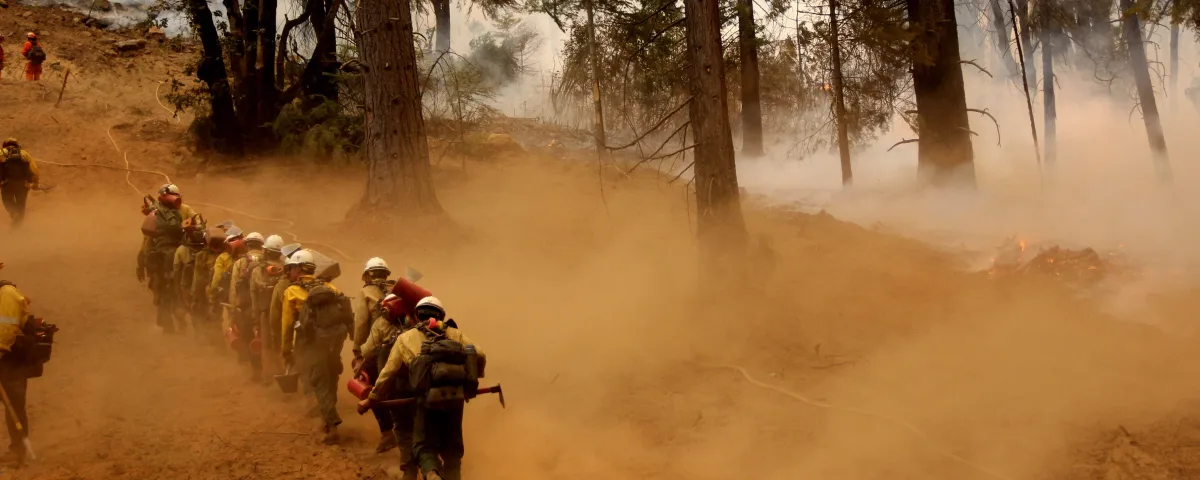
A hotshot crew is a Type 1 hand crew of 20 to 22 people that trains together full time and goes anywhere in the country on two hours’ notice. NIFC counts 90 federal hotshot crews, 68 Forest Service and 22 Interior; the Forest Service says more than 100 exist counting state sponsors.
The hotshot standards set the floor. Each crew needs at least seven permanent leaders, four intermediate sawyers and half the crew certified as basic fallers. It must be available at least 90 consecutive days a year and train as a unit 40 hours a week.
Type 2 IA and Type 2 crews do the same digging with less built in. Neither is a full-time organized crew, neither is required to bring its own transportation or tools, and the Red Book rates their line production at 0.8 of a hotshot crew’s.
- Type 2 IA: led by a crew boss and three squad bosses qualified as Type 5 incident commanders, so it can split up for initial attack. It carries three sawyers.
- Type 2: a crew boss and three Firefighter Type 1 squad bosses, no sawyers required. The Forest Service contracts Type 2 crews nationally, and the national dispatch center assigns them by best value.
The physical gap is real. A 2019 BLM recruiting flyer says hotshot gear can top 65 pounds, hikes to the line can pass four miles with 2,500 feet of climb, and shifts can last 16 hours.
Under Interior’s rules, a hotshot crew that falls below standard drops to Type 2 IA status until it qualifies again.
Hotshot vs engine crew: which should you pick?
Pick an engine if you want initial attack, water and early responsibility on a small crew. Pick a hotshot crew if you want large fires, long hikes and travel. Both start at GW-3 on the 2027 Forest Service announcements.
Engine work is built around the truck. BLM describes its engines as a “primary, first-on-scene” resource whose main tools are hose and water, plus portable pumps, foam, hand tools, saws and prescribed fire equipment. Engine crews also patrol, run prescribed burns and do fire prevention.
Small crews mean responsibility comes fast. The Red Book requires two people on a Type 5, 6 or 7 engine and three on a Type 3 or 4, one an engine boss; Forest Service engines also need a basic faller. Engine crews can generally command fires up to Type 4 complexity.
Hotshot crews spend, in the Forest Service’s words, “more days on the fire line than any other ground-based firefighting resource.” You will learn saws, firing operations and large-fire tactics from at least seven career leaders. BLM’s flyer adds that hotshots are often away from home through spring and summer.
Helitack vs hotshot, and where do smokejumpers fit?
Helitack and smokejumpers are initial attack crews that fly; hotshots are a ground crew for big fires. The Red Book says the primary mission of Interior’s exclusive-use helicopter programs in the lower 48 is initial attack, though they also work extended attack and large fires.
Helitack crews fly to a fire, size it up and build line with hand tools and saws. They also direct bucket drops, build landing zones and move people and cargo. After a fire, the Forest Service notes, crewmembers may hike out with up to 120 pounds of gear.
Rappelling is a subset of helitack. The Gallatin rappel crew calls itself one of 12 national rappel crews in the West, and new rappellers complete a weeklong rookie academy in Salmon, Idaho. Four Forest Service helitack crews also do emergency medical short-haul.
Smokejumping is the most selective of these jobs. The Forest Service has about 320 jumpers at seven bases, and Interior runs two more, in Boise and Fairbanks. Interior’s Boise base says it receives hundreds of applications for five to ten openings a year.
Jumpers need prior firefighting experience; Interior names engines, helitack, hotshots and fuels crews as typical backgrounds. Missoula runs a five-week rookie program with a 110-pound pack test in 90 minutes and a height range of 5 feet to 6 feet 5 inches. Boise says no parachute training is needed.
How does each crew spend a fire season?
Engines, helitack and smokejumpers are built for initial attack on new fires; hotshot and Type 2 crews are built for 14-day assignments on large ones. Fuels crews focus on thinning and prescribed burns and reconfigure into hand crews when needed.
Hotshot seasons run long. The Zigzag Hotshots on Oregon’s Mt. Hood National Forest describe a 90 to 120 day fire season with fires across the West, Alaska and Canada. Nevada’s Black Mountain Hotshots ask for a 5 to 6 month commitment with little personal time.
Between fires, hotshots train at least an hour a day, five days a week, and do project work for their host unit. Smokejumpers fly 8 to 12 to a load, and a typical mission takes 30 minutes over the fire.
Every federal crew works under the same assignment rules in the 2026 Red Book:
- 14 days is the standard assignment, not counting travel to and from home. Time in staging counts.
- 3 days off after a 14-day assignment, on the days right after you return (“3 after 14”).
- Extensions of up to 14 more days are allowed, for 30 days in all, with 2 days off before day 22.
- 2:1 work to rest: one hour of sleep or rest for every two hours of work or travel. Shifts over 16 hours should be the exception and must be justified.
- At home: Forest Service crews get at least 2 days off in any 14-day stretch of local fire activity.
Contract crews and emergency (AD) hires are not entitled to the paid days off after an assignment.
How do you become a hotshot?
Get one season on an engine, hand crew or fuels crew, then apply to hotshot crews in August. With at most four first-year spots per crew, a season of experience is the most reliable way in.
Superintendents say so on their own pages. The Zigzag Hotshots write that prior wildland fire experience “is generally recommended,” and that chainsaw experience, helitack qualifications, an EMT card and NWCG training help. Black Mountain says its turnover averages 10 to 20 percent, or 2 to 4 openings a year.
- Get a season in. Apply to engines, federal or state hand crews and fuels crews. Interior’s smokejumper page points people without experience to hotshot, fuels, helicopter and engine crews.
- Call the crew in summer. The Forest Service tells applicants to contact the crew they want around early August. Zigzag asks applicants to reach the superintendent or assistant early, and Black Mountain invites questions before you apply.
- Apply on USAJOBS. Hotshot jobs are posted there, generally between early August and October. Forest Service temporary announcements for 2027 ran July 31 to August 14, 2026; check Fire Hire 2027 for the permanent dates.
- Only pick places you would go. The Forest Service warns to apply only where you would accept an offer. Zigzag makes selections from late November into January.
- Train like a hotshot. Black Mountain’s program includes 3 to 6 mile runs and hikes of 1,000 to 2,000 vertical feet. Aim for the national goals in the table above.
Moving up the crew follows the red card. Senior firefighters need Firefighter Type 1 plus pump, saw, air operations and S-131 and S-133 courses; squad leaders need crew boss and Type 5 incident commander. Open state and contract crew jobs are listed on our wildland firefighter jobs board.
Frequently asked questions
Can I be a hotshot in my first season?
Yes, but spots are scarce. The hotshot standards cap first-year firefighters at 20 percent of the crew, or 4 positions, and the Forest Service’s 2027 GW-3 announcements listed hotshot crews among the entry jobs. Expect stiff competition for those seats.
Do hotshots get paid more than engine crews?
Not per hour. A 2027 GW-3 job was posted at $21.14 an hour in the Rest of U.S. whether it was on an engine, hotshot crew, helitack or hand crew. Season totals differ with overtime, hazard pay and incident premium pay; see wildland firefighter pay and the GW pay scale.
How long is a wildland fire assignment?
Fourteen days, not counting travel, under the 2026 Red Book. You then get 3 days off. An assignment can be extended by up to 14 days, for 30 days in all, with 2 days off before day 22.
What is the difference between a Type 1 and Type 2 hand crew?
A Type 1 crew, the hotshots, has permanent leadership, trains together 40 hours a week, brings its own trucks and tools and needs 80 percent of members with a prior season. A Type 2 crew needs 20 percent, has no required sawyers and needs transportation and tools supplied.
Is a fuels crew a good first fire job?
It can be. Fuels crews of about 10 do thinning, chainsaw work and prescribed fire, and reconfigure into hand crews for wildfires. Interior lists them among GW-3 entry jobs and as a path toward smokejumping, but project work is their main job.
Sources
- U.S. Wildland Fire Service and USDA Forest Service, Interagency Standards for Fire and Fire Aviation Operations (Red Book), May 2026, chapters 2, 7, 13, 14 and 16, via the NIFC Red Book page, accessed Oct 26, 2026.
- National Interagency Fire Center, Standards for Interagency Hotshot Crew Operations, Jan 21, 2016, accessed Oct 26, 2026.
- National Interagency Coordination Center, 2026 National Interagency Standards for Resource Mobilization, chapter 30, Crews, accessed Oct 26, 2026.
- National Interagency Fire Center, Crews and U.S. Wildland Fire Service Fuels Crews; Great Basin Smokejumpers recruitment, accessed Oct 26, 2026.
- U.S. Department of the Interior, Types of Crews, updated June 2026, accessed Oct 26, 2026.
- USDA Forest Service, Hotshots, Smokejumpers, Smokejumper qualifications, Missoula Smokejumpers employment, Helitack, Gallatin Rappel Crew and Engines, accessed Oct 26, 2026.
- USDA Forest Service crew pages: Zigzag Hotshots, Mt. Hood National Forest, and Black Mountain Hotshots, Humboldt-Toiyabe National Forest, accessed Oct 26, 2026.
- Bureau of Land Management Office of Fire and Aviation recruiting flyers (2019): Hotshot Crews, Engine Crews and Helitack, accessed Oct 26, 2026.
- USAJOBS announcements: Forest Service 27-TEMPF2-R1-2PC033-3DH and 27-TEMPF2-R6-2PC033-3DH (Wildland Firefighter, GW-3, open Jul 31 to Aug 14, 2026) and 27-TEMPF2-R6-2PC036-6DH (Smokejumper, GW-6); U.S. Wildland Fire Service WFS-FIRE-2026-028-DHA (multiple crew types, GW-3 to GW-5), WFSDHA-27-13078637-CGR1 (GW-4 to GW-6, career-seasonal) and WFS-FIRE-2026-033-DHA (Smokejumper, GW-5), accessed Oct 26, 2026.