
TL;DR
- A TWIC card costs $124 for a new applicant ($93 at the reduced rate) and is valid five years. Kirby Inland Marine and Washington State Ferries require it before you apply.
- The entry-level Coast Guard Merchant Mariner Credential (Ordinary Seafarer) has no exam. You pay a $95 evaluation fee and a $45 issuance fee, pass a drug test and get a medical certificate. Fishing vessels are exempt from the law that requires it on ships of 100 gross tons or more.
- Pay depends on the boat: a crew share on fishing boats, $221 a day on a Kirby towboat in 2026, $17.68 to $18.71 an hour on Texas oyster boats for the 2026-27 season, and $28.29 to $34.28 an hour for Washington State Ferries on-call deckhands. The BLS median for sailors and marine oilers was $24.77 an hour in May 2025.
- An Alaska commercial crewmember license costs $60 for residents and $220 for nonresidents. AMSEA’s Coast Guard-accepted drill conductor course was free for commercial fishermen at its April 12, 2026 Sitka class.
A deckhand is the entry job on every working boat. You handle lines, clean, paint, stand lookout and do what the captain needs, whether that means hauling crab pots, loading cars onto a ferry or chipping rust on a towboat. What changes from boat to boat is the paperwork and the pay: a fishing boat may take you with a state crew license and pay a share of the catch, while Washington State Ferries will not consider you without two federal credentials and pays by the hour.
For Alaska salmon seasons, cannery work and crew-share math on specific Alaska fisheries, read how to get an Alaska fishing job.
What does a deckhand do on each kind of boat?
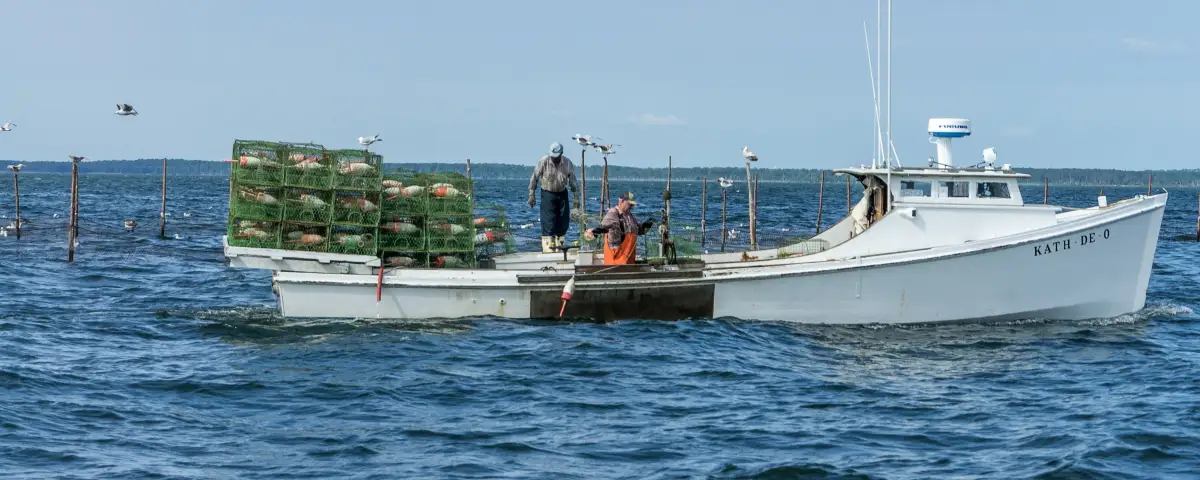
Everywhere it is lines, cleaning and maintenance; the boat decides the rest. On fishing boats, the Bureau of Labor Statistics lists deckhand duties as baiting, setting lines or traps, hauling in and sorting the catch, maintaining the boat and gear, and handling mooring lines. On an inland towboat, Kirby Inland Marine’s deckhands handle lines 4 to 8 times during each barge load or discharge, chip rust, prime and paint, and cook and clean when the master asks.
On research ships, a NOAA ordinary seaman chips, scales and paints, stands helm and lookout watches, and helps deploy scientific equipment, small boats and nets. Washington State Ferries deckhands operate vehicle loading bridges, secure cars and take part in emergency drills. Charter and whale-watch deckhands add passenger care, which the BLS counts as part of the deckhand job on passenger vessels.
| Deckhand job | Pay structure (published figure) | Season or schedule | Credentials | Source |
|---|---|---|---|---|
| Commercial fishing | Crew share of the catch; Texas oyster boats $17.68–$18.71/hr for 2026–27 | Alaska salmon in summer; factory trawlers 3–4 months away; Texas oysters mid-October to May | No MMC on fishing vessels; Alaska crewmember license $60 resident, $220 nonresident | BLS; American Seafoods; DOL SeasonalJobs; ADF&G |
| Charter and sportfishing | Salary or per-trip pay plus tips | May to September at one Seward, Alaska operator | Pre-employment drug test, because the boat must run with a licensed captain | Miller’s Landing; In The Bite; 46 CFR Part 16 |
| Whale-watch and tour boats | Hourly plus gratuity; $16/hr galley crew | April to October on Cape Cod | Pre-employment and random drug tests | Hyannis Whale Watcher; Bar Harbor Whale Watch |
| Research vessels | Salary; NOAA base $41,223–$43,987 | Mixed tour of full-time, part-time and intermittent work | MMC with entry-level ratings, medical certificate, drug test, U.S. citizen, 18+ | NOAA OMAO |
| Tugs and towboats | Day rate; $221/day at Kirby in 2026 | 2-for-1 rotation, up to 30 days aboard, 12-hour shifts | TWIC in hand before applying, Coast Guard physical, drug testing, 18+ | Kirby Inland Marine |
| Ferries | Hourly; $28.29–$34.28/hr at Washington State Ferries | On-call, 32–40 hours a week, not guaranteed | TWIC, MMC with OS or AB, medical certificate, basic firefighting and personal survival training | WSDOT |
When do you need a TWIC card, and what does it cost?
You need a Transportation Worker Identification Credential if you work unescorted in secure areas of regulated port facilities and vessels, or if you hold a Coast Guard Merchant Mariner Credential and serve on a vessel with a security plan. TSA says the card covers workers who need access to secure maritime areas, including most Coast Guard-licensed mariners. The Coast Guard’s TWIC rule, 46 CFR 10.203, requires MMC holders to carry one, but Policy Letter 11-15 lets mariners who work only on vessels without a security plan get and renew an MMC without it.
The TWIC fee is $124 for a new card or an in-person renewal, $116 to renew online, $93 at the reduced rate and $60 to replace a card. It is valid five years. TSA recommends enrolling at least 60 days before you need the card because processing can take more than 45 days. You enroll in person with fingerprints, a photo, and documents such as a passport, or a driver’s license plus a birth certificate.
Employers set the practical rule. Kirby Inland Marine wants a valid TWIC in hand before you apply, Washington State Ferries requires one to apply, and New York City’s Staten Island Ferry gives new deckhands 30 days to get one. If you want tug or ferry work, get the TWIC first.
Do deckhands need a Merchant Mariner Credential or a state license?
You need an MMC to serve on a merchant vessel of 100 gross tons or more, unless the vessel is exempt. 46 U.S.C. 8701 exempts fishing vessels, fish tenders, yachts, most barges, and vessels that run only on rivers and lakes other than the Great Lakes. So a deckhand on a salmon seiner does not need one, while a deckhand on a large ferry or research ship does. Employers can require it on any boat: NOAA and Washington State Ferries both list an MMC as a minimum qualification.
The entry-level ratings are Ordinary Seafarer (still called ordinary seaman in most job listings), Wiper and Steward’s Department, and the Coast Guard issues them without a professional exam. An Ordinary Seafarer may fill any unqualified job in the deck or steward’s department except food handler. The MMC fees are a $95 evaluation fee and a $45 issuance fee, paid through Pay.gov since January 19, 2025. You also need a Coast Guard medical certificate and a passing drug test dated no more than 185 days before you apply.
Sea time moves you up. Able Seafarer-Fishing Industry takes six months on deck, not as a processor; Able Seafarer-Special takes 12 months; Able Seafarer-Limited takes 18 months on vessels of 100 gross tons or more. Every Able Seafarer rating requires you to be 18.
Alaska adds a state license. Anyone who handles gear or helps with navigation, docking or maintenance on a commercial fishing boat needs an ADF&G crewmember license, and every crew member needs a Social Security number. The current price list shows $60 a year for residents, $220 for nonresidents, or a $30 seven-day license limited to one per year. Workers who only process fish aboard a processing vessel are exempt.
Will a marine employer drug test you?
Yes, if you count as a crewmember under Coast Guard rules. 46 CFR 16.210 says no marine employer may hire a crewmember until the person passes a drug test for that employer. “Crewmember” covers anyone serving under a Coast Guard credential and anyone employed on a vessel that must be operated by a credentialed mariner. That includes charter boats carrying passengers for hire, because 46 U.S.C. 8903 requires a licensed operator on them.
The urine test screens for marijuana, cocaine, opiates, PCP and amphetamines under the Department of Transportation procedures in 49 CFR Part 40. After you are hired, crew filling positions on an inspected vessel’s Certificate of Inspection, and crew doing safety-related work on uninspected vessels, go into a random pool. The regulation sets the minimum annual random rate at 50 percent of covered crewmembers unless the Coast Guard lowers it. You can also be tested after a serious marine incident or for reasonable cause.
Employers put it in their listings. Bar Harbor Whale Watch Co. requires a Coast Guard pre-employment drug test and random testing for its 2026 deckhands, and Hyannis Whale Watcher Cruises requires pre-employment and random screens. If you fail, you cannot return to a vessel until a Medical Review Officer clears you, and you then face at least six unannounced tests in your first year back.
How are deckhands paid: crew shares, day rates or hourly?
Fishing boats usually pay a crew share; other boats pay a day rate or an hourly wage. The BLS says fishers are typically paid a crew share, a percentage of the boat’s catch that grows with the catch and swings from season to season. American Seafoods pays its factory trawler crews a crew share deposited 10 business days after each trip. Federal law exempts fishing work from minimum wage and overtime (29 U.S.C. 213), so a poor trip can pay very little. On fishing vessels of 20 gross tons or more leaving a U.S. port, the owner must give each crew member a written fishing agreement that states the period and the share or wage terms before the voyage.
Towboats pay by the day, and charter boats pay a salary or per-trip rate plus tips. Kirby pays entry-level inland deckhands $221 a day plus benefits in 2026. Miller’s Landing in Seward pays its marine crew a salary plus tips, and a 2022 In The Bite article quoted a Hatteras charter mate at $100 to $150 per trip from the captain plus tips of 15 to 20 percent of the charter price. Federal law exempts “any employee employed as a seaman” from overtime.
Ferries, tour boats and some fishing operations pay hourly. Washington State Ferries posted $28.29 to $34.28 an hour for on-call deckhands in its October 2025 opening. Texas oyster boats filing seasonal job orders for 2026-27 list $17.68 an hour at Miller Seafood in Port Lavaca and $18.71 at Misho’s Oyster Company in San Leon, for 35-hour weeks.
The federal wage series for ordinary and able seamen is 53-5011 Sailors and Marine Oilers: 31,670 jobs in May 2025, a median of $24.77 an hour or $51,520 a year, with the bottom 10 percent under $16.61 and the top 10 percent over $40.20. The fishing series, 45-3031 Fishing and Hunting Workers, has no current estimate; BLS last updated its wage in May 2017, when the median was $28,530 a year.
Who hires deckhands with no experience?
These employers and programs publish entry-level openings or list no experience requirement:
- Washington State Ferries calls its on-call deckhand job entry-level, with maritime experience preferred but not required and full-time paid training. You still need the TWIC and MMC before you apply.
- Kirby Inland Marine hires entry-level inland deckhands in Channelview, Texas, pays for required training, and prefers 12 months of consecutive work experience.
- NOAA lists the entry-level MMC and a medical certificate as its minimum qualifications for ordinary seaman, with ships based in Kodiak, Ketchikan, Newport, Oregon, San Diego, Honolulu, Pascagoula, Woods Hole and Norfolk, among others.
- Texas oyster boats: Miller Seafood’s 2026-27 job order says no education, experience or training required, for October 13, 2026 to May 12, 2027.
- The Alaska Longline Fishermen’s Association Crew Training Program has placed more than 100 apprentices on Southeast Alaska boats since 2015, for trips from one day to 3 or 4 months. Finalists for 2026 were told to expect calls from skippers from late April to June.
- Factory trawlers: Alaska’s job center says companies usually hire new workers as processors and promote them to deck, and American Seafoods says many of its department heads and licensed crew started as processors.
Experience pays. The Staten Island Ferry’s deckhand posting, which closed April 10, 2026, required an Able Seaman endorsement, a lifeboatman endorsement and two years as a paid deckhand, and paid $64,193 to $73,821.
How do you find a boat, and what training and gear do you need?
Walk the docks and use the crew boards that exist. The BLS says many new fishers find work through family or friends or by walking the docks and asking. Alaska’s crew guide warns that crew rarely leave good jobs, so only a small percentage of dock-walkers find a berth, that replacement crew often come through family or an industry association, and that skippers hire well before the season.
For boards, the Alaska Job Center Network’s fishing vessel page posts a deckhand job-seeker flyer and the contact for its Anchorage seafood office, and the At-Sea Processors Association links to member companies’ hiring pages and holds its next job fair on October 29, 2026. Open listings on WildWork are at deckhand jobs, fishing crew jobs and Alaska jobs, and you can post a job-wanted profile so captains can find you.
Take a drill conductor course before you go. Commercial fishing vessels must hold drills and instruction at least once a month, and only someone trained to conduct them may run them (46 CFR 28.270). AMSEA’s 10-hour and 16-hour drill conductor courses meet that requirement; its April 12, 2026 class in Sitka was free for commercial fishermen and $250 for everyone else. Washington State Ferries requires two-day basic firefighting and personal survival training, treading water for 60 seconds and lifting 50 pounds.
Pack rain gear, rubber boots, gloves, wrist covers and a sleeping bag; Alaska’s crew guide says the vessel owner should supply Coast Guard gear such as a survival suit. Bring your documents: Kirby asks for a TWIC, a driver’s license, a state-issued birth certificate and a Social Security card, and NOAA requires that you can get a U.S. passport.
Frequently asked questions
Do I need a TWIC to work on a fishing boat?
Not under the federal rules. The TWIC requirement attaches to Merchant Mariner Credential holders on vessels with a security plan and to unescorted access in secure areas, and fishing vessels are exempt from the law that requires an MMC on vessels of 100 gross tons or more. An employer can still ask for one, as Kirby does for towboat work.
How old do you have to be to work as a deckhand?
Kirby and NOAA require you to be 18, and every Coast Guard Able Seafarer rating requires 18. Alaska law bars anyone under 16 from working on a fishing boat unless a parent operates it, and 16 and 17 year olds need a state work permit.
How much does a first-year deckhand make?
Published entry pay in 2025 and 2026 listings runs from $16 an hour on a Cape Cod whale-watch galley crew to $221 a day on a Kirby towboat and $28.29 to $34.28 an hour on Washington State Ferries. NOAA ordinary seamen earn a base of $41,223 to $43,987, which NOAA says averages $63,167 with overtime and allowances. Fishing shares have no minimum wage floor and depend on the catch.
Is an Able Seafarer endorsement worth getting?
Yes if you want ferry or ship work. The Staten Island Ferry required an Able Seaman endorsement and paid $64,193 to $73,821 in a posting that closed April 10, 2026, and Washington State Ferries hires AB holders as well as entry-level crew. Able Seafarer-Fishing Industry needs six months on deck, Able Seafarer-Special needs 12 months, and both require an exam.
Sources
- Transportation Security Administration, “TWIC”, fees, validity and processing time, accessed Sep 13, 2026.
- U.S. Coast Guard National Maritime Center, “Transportation Worker Identification Credential” (46 CFR 10.203 and Policy Letter 11-15), accessed Sep 13, 2026.
- eCFR, 46 CFR 10.219, Fees, and National Maritime Center, Merchant Mariner Credentialing Fees, accessed Sep 13, 2026.
- eCFR, 46 CFR Part 12, Requirements for Rating Endorsements (sections 12.401, 12.403, 12.701, 12.703), accessed Sep 13, 2026.
- eCFR, 46 CFR Part 16, Chemical Testing (sections 16.105, 16.113, 16.201, 16.210, 16.220, 16.230), accessed Sep 13, 2026.
- eCFR, 46 CFR 28.270, Instruction, drills, and safety orientation, accessed Sep 13, 2026.
- Legal Information Institute, 46 U.S.C. 8701, 46 U.S.C. 8903, 46 U.S.C. 10601 and 29 U.S.C. 213, accessed Sep 13, 2026.
- Alaska Department of Fish and Game, Crewmember License Information and License, Stamp, and Tag Pricing List, accessed Sep 13, 2026.
- Alaska Department of Labor and Workforce Development, Fishing vessel jobs and “Preparing to Work On-board Fishing Vessels”, accessed Sep 13, 2026.
- Alaska Marine Safety Education Association, Marine Safety Training for Commercial Fishermen and Fishing Vessel Drill Conductor Course, Sitka, April 12, 2026, accessed Sep 13, 2026.
- Bureau of Labor Statistics, OEWS Profiles, 53-5011 Sailors and Marine Oilers, May 2025, accessed Sep 13, 2026.
- Bureau of Labor Statistics, Occupational Outlook Handbook, Fishing and Hunting Workers (45-3031, wage data last updated May 2017) and Water Transportation Workers, accessed Sep 13, 2026.
- U.S. Department of Labor, SeasonalJobs.dol.gov job orders: Miller Seafood Company, H-400-26196-101462 and Misho’s Oyster Company, H-400-26196-101285, accessed Sep 13, 2026.
- Kirby Inland Marine, Entry Level Inland Deckhand, Job ID 2026-3717, accessed Sep 13, 2026.
- Washington State Department of Transportation, Employment with Washington State Ferries and On-Call Deckhand posting, Oct 22 to Nov 11, 2025, accessed Sep 13, 2026.
- NYC Department of Transportation, Deckhand (Ferry), Staten Island, job ID 727293, accessed Sep 13, 2026.
- NOAA Office of Marine and Aviation Operations, Ordinary Seaman (General Vessel Assistant), accessed Sep 13, 2026.
- Bar Harbor Whale Watch Co., Employment and Hyannis Whale Watcher Cruises, Jobs, accessed Sep 13, 2026.
- Miller’s Landing, Employment in Seward Alaska, accessed Sep 13, 2026.
- American Seafoods, Fishing Boat and Crew Jobs and At-Sea Processors Association, Job Opportunities, accessed Sep 13, 2026.
- Alaska Longline Fishermen’s Association, Crew Training Program, accessed Sep 13, 2026.
- In The Bite, “A Mate’s Pay In The Sportfishing Industry,” November 2022, accessed Sep 13, 2026.