
TL;DR
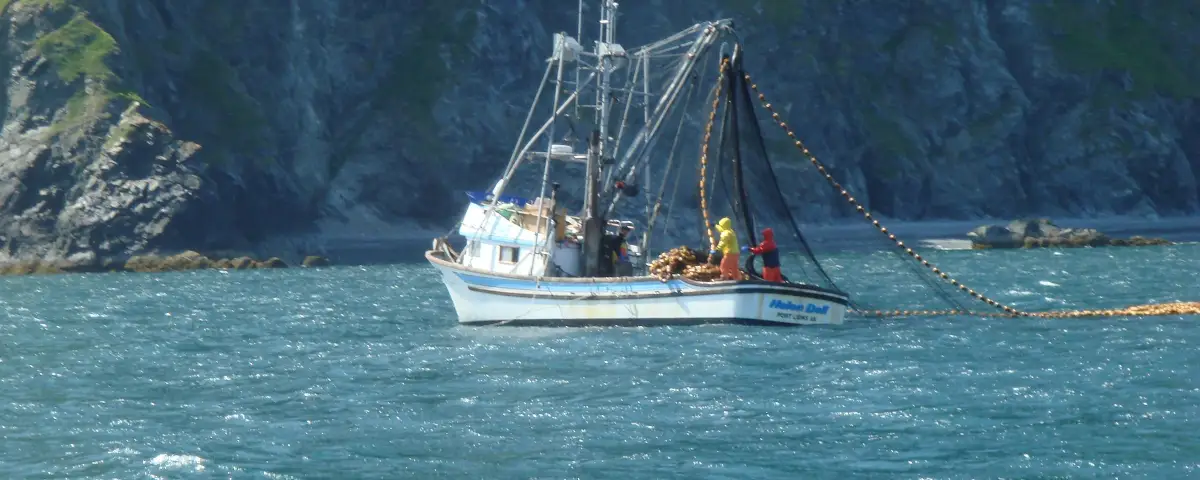
- Deckhands are paid a crew share, not a wage. The state’s own guidance puts newcomer shares at 1.5 to 10 percent of the adjusted gross catch, and minimum wage does not apply on fishing boats. Bristol Bay’s total value swung from $128 million in 2024 to $215 million in 2025, and your share swings with it.
- Processing plants pay a real wage: $17.91 an hour to start at the largest employer in 2026, overtime after 8 hours a day, $15 a day for room and board, and airfare home if you finish the contract.
- Lodge crew at a Sitka charter lodge are quoted $4,000 to $6,500 a month with housing and meals, May 15 to September 15.
- Nobody honest charges you to get an Alaska fishing job. The state job center is free and says so.
Alaska fishing jobs are real, they are hard, and a lot of what is written about them online is either decades old or trying to sell you a list. This article uses the state’s own fishery reports, labor department guidance and employer pages to show what each kind of job pays, what it costs you, and how to tell a real offer from a scam.
What kinds of Alaska fishing jobs exist?
| Job | Season | Pay | Housing | Experience |
|---|---|---|---|---|
| Deckhand, salmon seiner or gillnetter | Mid-June to September | Crew share, 1.5–10% for newcomers | Bunk and food aboard, often charged against your share | None required; fitness and commitment |
| Processor, shore plant | Sockeye: mid-June to mid-July; pinks to September; winter whitefish and crab | $17.91/hr start, 1.5× after 8 hrs/day | Bunkhouse and cafeteria, $15/day, half refunded on completion | None |
| Lodge crew | Mid-May to mid-September | $4,000–$6,500/month at one Sitka lodge, incl. tips and bonus | Included with meals | None for most roles |
| Sport fishing guide | May to September | Day rate plus tips | Usually included | ADF&G registration; USCG license for motorized boats |
| Charter deckhand | May to September | Day rate plus tips | Often included | None; exempt from guide registration under a registered guide |
How does a deckhand crew share work?
You are paid a percentage of what the boat catches, after expenses. The Alaska Department of Labor’s guidance for new crew says wages “are often based on a share or percentage of harvest earnings,” that newcomer deckhand earnings “range from 1.5% to 10% of the adjusted gross catch,” and that “minimum wage laws do not apply to crew member jobs” (Alaska Department of Labor and Workforce Development, “Preparing to Work On-board Fishing Vessels”, accessed Sep 13, 2026). Many boats charge crew a share of food, fuel, bait and ice, and expect gear and vessel work without extra pay. The state tells new crew to get a signed work agreement that explains the pay before leaving the dock.
The catch and the price decide what that percentage is worth. In 2024 Bristol Bay harvested 31.6 million sockeye at an average $0.89 per pound and the smallest average fish on record, for a total value of $128.1 million, 34 percent below the 20-year average. In 2025 the harvest was 41.2 million at $1.03 per pound, for $215.3 million, 7 percent above the 20-year average (Alaska Department of Fish and Game, Bristol Bay season summaries, Sep 17, 2024 and Sep 24, 2025). A 5 percent share of a boat that grossed $200,000 is $10,000; the same boat in the bad year might have grossed $110,000. Kodiak purse seine permits averaged $241,807 in 2025 against $102,178 in 2024 (ADF&G Kodiak season summary, accessed Sep 13, 2026). Expect variance and do not spend the money before it clears.
Before you can work, you need an Alaska commercial crewmember license: $60 for residents, $220 for nonresidents for the year, or a $30 seven-day license, limited to one a year, sold online by ADF&G (ADF&G license prices, accessed Sep 13, 2026). Processing-only workers on a processing vessel do not need one. You must be 16 or older to work on a fishing boat unless a parent runs it, and 16 and 17 year olds need a state youth work permit.
What do cannery jobs really pay after housing?
Processing plants are the one Alaska fishing job with a guaranteed hourly wage. Silver Bay Seafoods, which runs plants from Naknek and Dillingham to Sitka and Ketchikan, starts at $17.91 an hour in 2026, or up to $19.11 with experience, pays 1.5 times the rate after 8 hours in a day or 40 in a week, charges $15 a day for room and board only on days you work more than 8 hours, refunds half of that if you finish the season, and covers airfare from major U.S. airports and a return flight on completion (Silver Bay Seafoods 2026 listing, accessed Sep 13, 2026). For the 2026 summer season that listing was open only to workers with previous Alaska processing experience. Trident Seafoods charges the same $15 a day after an 8-hour day and provides round-trip airfare from its hub airports, with dorm rooms shared by two to six people (Trident Seafoods, accessed Sep 13, 2026). Westward Seafoods’ filing for the 2025–26 winter season listed $17.91 an hour, overtime after 8 hours a day or 40 a week, and optional housing at $20 a day (U.S. Department of Labor Seasonal Jobs, accessed Sep 13, 2026).
The math on a peak sockeye contract: six weeks at 16 hours a day means 8 regular and 8 overtime hours daily. At $17.91 that is $143 regular plus $215 overtime, about $358 a day before tax, or roughly $2,500 a week, minus $105 for room and board. Plants state plainly that there are no guaranteed hours; the run decides. Alaska law backs the overtime: shore-plant processors get 1.5 times pay after 8 hours a day or 40 a week, room and board deductions must be by signed agreement and reasonable, and an employer that pays your way to the job owes you return transportation when the job ends unless you were fired for cause or quit (Alaska Department of Labor, industry letter to seafood processors, May 6, 2025). Alaska’s minimum wage rose to $14 on July 1, 2026 and goes to $15 in July 2027.
Scale: seafood processing employed 3,493 Alaska residents and 15,348 nonresidents in 2024, 81.5 percent from outside the state (Alaska Economic Trends, Feb 2026). It is the easiest Alaska job to get and the hardest on the body.
What is lodge work like?
Fishing lodges hire dock hands, fish processors, housekeepers, servers, cooks and guides from mid-May through mid-September. Kingfisher Charters and Lodge in Sitka publishes what a season can produce with overtime, tips and end-of-season bonus: $4,000 to $5,000 a month for housekeeping and serving, $4,500 to $5,000 for a morning departure assistant, and $5,700 to $6,500 for a line cook, with housing and meals included (Kingfisher Charters, accessed Sep 13, 2026). Brooks Lodge in Katmai runs late May to mid-September with accommodations and meals at no cost (Katmailand, accessed Sep 13, 2026). Smaller lodges pay less and work you eight days on, one off. Lodge kitchen staff need an Alaska food handler card.
How do I spot a fake Alaska fishing job?
- It charges a fee. The state job center says “there is no fee for using Alaska Job Center Network services,” and the FTC says “honest employers, including the federal government, will never ask you to pay to get a job” (Alaska DOLWD; Federal Trade Commission, accessed Sep 13, 2026). Sites that sell “Alaska fishing job lists” are selling lists, not jobs.
- It promises big money for easy work. The state warns that published materials “boast of lucrative jobs in canneries and on fishing boats” and that “for every success, there are many failures.”
- A boat with lots of crew openings mid-season. The state says a vessel with numerous vacancies during the harvest “warrants investigation.”
- No written agreement. Real skippers and plants put the pay, the season dates, the housing charge and the airfare policy in writing.
- Report fraud to the Alaska Consumer Protection Unit at 907-269-5200.
WildWork checks every employer who posts before the listing goes live, labels listings it has not checked yet, and refuses any listing that asks workers for money. Deckhand and crew listings here state the pay structure.
When are the seasons?
| Fishery | Timing | Note |
|---|---|---|
| Bristol Bay sockeye | Peak late June to mid-July; 2025 run one day earlier than the 20-year average | Six-week processor contracts |
| Southeast pink and chum seine | First seine openings in District 12 in late June (June 21 in 2026), early July elsewhere; runs into September | 2026 pink forecast 19 million, near average |
| Kodiak | Sockeye in June, pink focus from July 6, late pink and chum into September | 2025 pink harvest 34.6 million |
| Prince William Sound | Copper River sockeye from mid to late May (May 22 opener in 2026); pink seine mid-July to late August; coho into September | |
| Halibut charter | Sport season Feb 1–Dec 31, 2026; charters run roughly May to September | Area 3A closed every Wednesday, and Tuesdays Jun 2–Aug 25, 2026 |
Sources: ADF&G season summaries and forecasts for Bristol Bay, Southeast, Kodiak and Prince William Sound; NOAA Fisheries 2026 charter halibut regulations, Mar 24, 2026. Accessed Sep 13, 2026.
When and how do I apply?
Processors hire from January through May for the June run, and hire again for fall and winter whitefish. Lodges hire December through March. Skippers hire crew from January through May, and walking the docks in Homer, Kodiak, Petersburg or Cordova in early June still works, but fewer boats each year. You must be physically in Alaska to be referred by the state job center; you do not need to be for employer listings. Open Alaska listings are at wildwork.io/jobs/alaska/, and by type at deckhand, fishing crew and fishing guide.
What should I pack?
Rain gear bibs and jacket, rubber boots, wool and synthetic layers, work gloves, a good sleeping bag, and cash for a flight home if the job falls through. The state’s crew guide lists the same kit. Boats provide bunk and food; plants provide bedding. Leave anything you cannot afford to get soaked.
Frequently asked questions
Do Alaska fishing jobs pay for your flight?
Major processors pay airfare from approved hub airports to the plant and back if you complete the contract. Under Alaska law an employer that pays your transportation to a job owes return transportation when it ends, unless you are fired for cause or quit without misrepresentation. Boats vary; lodges sometimes reimburse after the season. Get it in writing.
Can I get an Alaska fishing job with no experience?
Yes. Processing plants hire thousands of first-timers every year, lodges hire green dock hands and housekeepers, and many salmon skippers take one new deckhand per season if they are fit and will stay through the run. Charter deckhands work under a registered guide with no license of their own.
How much can you save in one Alaska summer?
A processor working 16-hour days through a six-week sockeye peak grosses roughly $2,500 a week before tax at 2026 rates, with almost no living costs. A good deckhand share on a strong Bristol Bay or Kodiak season can exceed that; a poor season can fall well short. Lodge staff at the higher-paying lodges bank $16,000 to $25,000 for the summer.
Do I need a license to guide fishing in Alaska?
Sport fishing guides register with ADF&G for free and must carry the registration card, their employer’s business registration and a sport fishing license while guiding. Anyone operating a motorized boat with paying clients also needs a U.S. Coast Guard license. Deckhands working under a registered guide are exempt from registration.
Sources
- Alaska Department of Labor and Workforce Development, “Preparing to Work On-board Fishing Vessels” and Fishing Vessel Jobs page, jobs.alaska.gov, accessed Sep 13, 2026.
- Alaska Department of Labor and Workforce Development, Wage and Hour letter to shore-based fish processors, May 6, 2025; Summary of Alaska Wage and Hour Act, accessed Sep 13, 2026.
- Alaska Department of Fish and Game, crewmember license page and license prices, accessed Sep 13, 2026.
- Alaska Department of Fish and Game, 2024 and 2025 Bristol Bay Salmon Season Summaries; 2025 Kodiak and 2025 Prince William Sound Season Summaries; 2026 Prince William Sound fishery information; Southeast purse seine announcement, June 12, 2026 and 2026 pink forecast; 2026 Bristol Bay forecast, accessed Sep 13, 2026.
- Alaska Department of Fish and Game, sport fishing guide and business registration pages, accessed Sep 13, 2026.
- Silver Bay Seafoods 2026 experienced processor listing; Trident Seafoods, “Working in Alaska”; Westward Seafoods H-2B filing H-400-25305-356294 via U.S. Department of Labor Seasonal Jobs, accessed Sep 13, 2026.
- Kingfisher Charters and Lodge employment page; Katmailand (Brooks Lodge) employment page, accessed Sep 13, 2026.
- Rob Kreiger, “Nonresident workers on the rise,” Alaska Economic Trends, February 2026, accessed Sep 13, 2026.
- NOAA Fisheries Alaska Region, “2026 Regulations for Charter Halibut Anglers,” Mar 24, 2026; 46 U.S.C. 8903 and 46 CFR 11.467, accessed Sep 13, 2026.
- Federal Trade Commission, “Job Scams”; Better Business Bureau Scam Tracker; Alaska Department of Law Consumer Protection Unit, accessed Sep 13, 2026.
- Alaska Department of Labor and Workforce Development, minimum wage schedule under 2024 Ballot Measure 1 (press release 25-11), accessed Sep 13, 2026.