
TL;DR
- Wilderness First Aid is a 16-hour, two-day course; NOLS listed U.S. sessions at $250 to $380 for fall 2026. A Wilderness First Responder takes 70 to 80 hours: NOLS runs 80 hours, with U.S. sessions at $745 to $1,150 through March 2027, and WMA runs 70 hours in the U.S. from $700.
- The red card for entry wildland fire jobs needs no experience: five courses (ICS-100, IS-700, L-180, S-130, S-190) and the arduous pack test, 3 miles with a 45-pound pack in 45 minutes.
- The Coast Guard “six-pack” license (OUPV) requires age 18, 12 months of experience operating vessels, an exam, first aid and CPR, a drug test and a medical certificate. Fees are $100 for evaluation, $95 for the exam and $45 for issuance.
- Guide licenses are state by state: Montana charges $125 to apply and requires an outfitter’s endorsement; Idaho charges $105 plus a $20 application fee; an Alaska assistant guide pays $200 to apply and $310 for a resident license.
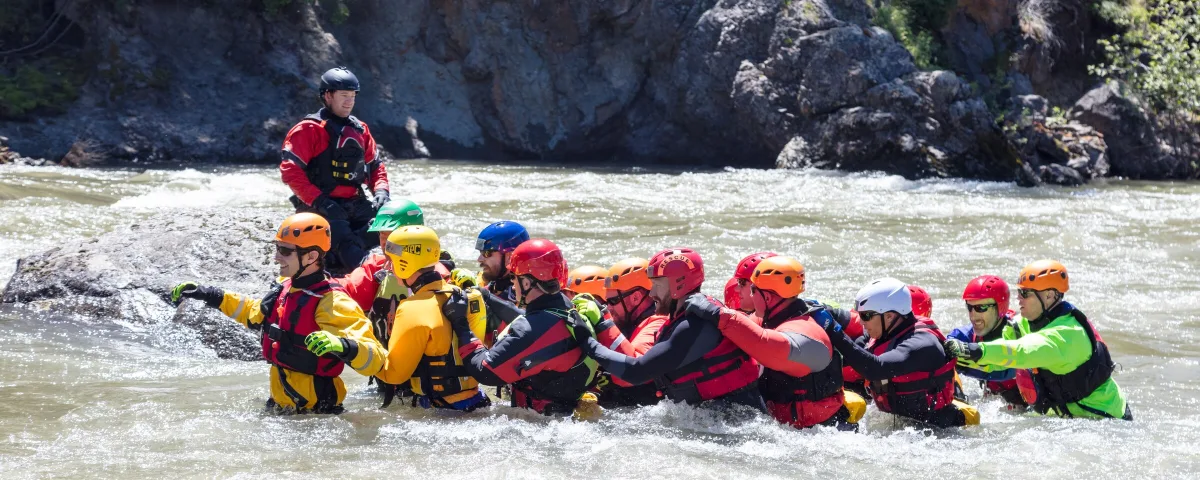
- Swiftwater rescue courses for river guides run two or three days and cost $250 to $525.
Most outdoor employers want first aid and CPR at a minimum. Guide jobs far from roads expect a Wilderness First Responder, and a handful of jobs need a legal credential: a red card for fire, a Coast Guard license to carry paying passengers on a boat, a state guide license to take hunters or anglers out for an outfitter, or a food worker card in some states.
Get the cheap, required ones before you apply, and let the expensive ones follow the job you are chasing.
Which certifications do outdoor jobs require?
It depends on the job, but first aid and CPR show up on almost every list. This table separates what employers usually ask for from what a law or agency rule requires.
| Job | Employers usually expect | Required by law or agency rule (examples) |
|---|---|---|
| Raft guide | CPR, WFA or WFR, swiftwater rescue | Grand Canyon guides: Wilderness Advanced First Aid or higher, CPR with hands-on skills testing, food handler certificate. Trip leaders: WFR |
| Fishing guide | First aid, CPR, state guide license | A licensed operator on any self-propelled uninspected passenger vessel (46 U.S.C. 8903); OUPV covers six or fewer passengers. Montana and Idaho guide licenses |
| Hunting guide | First aid, state guide license | Montana, Idaho, Wyoming and Alaska guide licenses; Wyoming hunter education card if born after January 1, 1966; Colorado outfitters’ guides need a first aid card or equivalent |
| Wildland firefighter | Red card (FFT2) | ICS-100, IS-700, L-180, S-130, S-190 and the arduous work capacity test (NWCG) |
| Trail crew sawyer | First aid, CPR | National Sawyer Certification Card (A, B or C) to run saws on national forest land, valid 3 years; chain saw sawyers must be 18 (Forest Service Manual 2358) |
| Camp or backcountry cook | First aid, food handler card | Alaska food worker card within 30 days of hire; Washington food worker card, with up to 14 days allowed if the employer trains you |
| Charter deckhand in Alaska | Varies by employer | Exempt from Alaska guide registration when working on the same vessel under a registered guide |
Sources: NPS Grand Canyon Commercial Operating Requirements (Feb 2026); 46 U.S.C. 8903 and 46 CFR 11.467; state boards listed below; NWCG PMS 310-1; Forest Service Manual 2358 (2023); Alaska DEC; Washington DOH; Alaska Department of Fish and Game. Accessed Sep 13, 2026.
Starting from nothing, CPR and a Wilderness First Aid course cover the most jobs for the least money. Our guide jobs page shows what current listings ask for.
What is the difference between Wilderness First Aid and a Wilderness First Responder?
Time and depth. A WFA is a two-day, 16-hour course; a WFR is a 70 to 80 hour course taught over 7 to 10 days. NOLS says its WFA suits people who work at camps or take trips where emergency help can be expected in fewer than eight hours, while its WFR prepares you to make medical decisions when help is hours or days away and is aimed at professional guides, expedition leaders and search and rescue teams. Wilderness Advanced First Aid sits between them; NOLS teaches it in 40 hours.
| Provider | WFA | WFR | How long it lasts | Recertification |
|---|---|---|---|---|
| NOLS | 16 hours; U.S. sessions $250 to $380 (fall 2026) | 80 hours over 9 or 10 days; U.S. sessions $745 to $1,150 (Sep 2026 to Mar 2027) | 2 years | WFR recert: 24 hours over 3 days, $280 to $490 |
| WMA International | 16 hours, from $200 | 70 hours in the U.S., 7 to 9 days, from $700 | 3 years | WFR recertification course |
| SOLO | 16 hours; price set by the sponsor | 72 or more hours, 8 to 10 days; $1,095 with class-day meals and lodging, or $895 as a day student, at Conway, NH | WFA 2 years, WFR 3 years | 2-day WFR refresher |
Sources: NOLS WFA, WFR, WAFA and WFR Recertification pages; WMA International WFA and WFR course pages; SOLO WFA and WFR pages. Accessed Sep 13, 2026.
The WFR includes more than first aid: NOLS graduates also earn adult, child and infant CPR and epinephrine auto-injector certifications. WMA says its WFA and WFR courses are Coast Guard approved to meet the first aid and CPR requirement for merchant mariner licenses, which matters if you are working toward a captain’s license. Colorado’s outfitter rules count Wilderness First Aid, Wilderness First Responder, American Heart Association and EMT training as equivalent to a Red Cross first aid card (4 CCR 733-1).
Do you need a separate CPR card or a food handler card?
You need current CPR for most guide jobs, and a WFR often covers it; a food handler card depends on the state and the job. Red Cross CPR certification lasts two years. Its online-only courses, which include no in-person skills check, issue a certificate of completion that the Red Cross says “may not meet workplace requirements.” Grand Canyon’s river rules accept online CPR only with proof of hands-on skills testing, and the Coast Guard accepts CPR only from the Red Cross, the American Heart Association or a Coast Guard approved course. SOLO’s basic CPR class runs 2 to 3 hours and its professional class 4 to 5 hours, both good for two years.
Food cards come up for camp cooks, lodge kitchens and river trips. In Alaska, the state food code requires anyone working with unpackaged food or food-contact surfaces to get a food worker card within 30 days of hire. The state test ID costs $10, the test is 20 questions with 15 correct to pass, and the card lasts three years; Anchorage runs its own separate program. Washington charges $10, lets you work up to 14 days before getting the card if your employer trains you, makes your first card good for two years, and accepts online cards only from foodworkercard.wa.gov. Grand Canyon guides need a food handler certificate as well. More on kitchen jobs is in backcountry cook jobs.
How do you get a red card for wildland fire jobs?
Complete five courses and pass the arduous pack test. The entry position is Firefighter Type 2 (FFT2), and NWCG lists no required experience, only ICS-100, IS-700, L-180 Human Factors, S-130 Firefighter Training and S-190 Introduction to Wildland Fire Behavior. The annual refresher, RT-130, is not required in your first year but is every year after. S-130 is blended: an online portion NWCG says takes about 13 hours, then an instructor-led field exercise that requires protective gear, usually supplied by your employing or host unit. S-190 and L-180 also come in self-directed online versions.
| Work capacity test | Distance | Pack weight | Time limit | Who takes it |
|---|---|---|---|---|
| Pack test (arduous) | 3 miles | 45 lb | 45 minutes | Fireline firefighters, including FFT2 |
| Field test (moderate) | 2 miles | 25 lb | 30 minutes | Moderately strenuous fire duties |
| Walk test (light) | 1 mile | None | 16 minutes | Light duty |
Source: NWCG Work Capacity Test Administrator’s Guide, PMS 307, November 2023; NWCG FFT2 qualification requirements. Accessed Sep 13, 2026.
You usually do not need the courses before you are hired, because agencies and contractors train new firefighters. Washington DNR asks for IS-700 and ICS-100 certificates by the day of its pack test, requires FFT2 certification once the test and courses are done, and runs its basic training at a 7 to 14 day academy. It strongly encourages applicants to train for the pack test, so start hiking with a loaded pack weeks ahead. Hiring timelines are in wildland firefighter jobs, and pay is in wildland firefighter pay.
What does a Coast Guard six-pack captain’s license require?
A year of documented time running boats, a Coast Guard exam, and a stack of paperwork. Federal law says a self-propelled uninspected passenger vessel must be operated by someone licensed for that type of vessel (46 U.S.C. 8903), and the Operator of Uninspected Passenger Vessels endorsement, called OUPV or six-pack, covers vessels under 100 gross tons carrying six or fewer passengers (46 CFR 11.467). If you plan to guide anglers from a motorboat you run yourself, this is the credential to plan for.
- Age: 18 or older.
- Experience: 12 months operating vessels for inland waters. Near-coastal, which for OUPV means up to 100 miles offshore, needs 12 months including 3 months on ocean or near-coastal waters. The rules count a month as 30 days and a day on a small vessel as 8 hours unless the Coast Guard decides otherwise, never less than 4.
- First aid and CPR: a first aid course completed within one year of applying and a current CPR certificate.
- Drug test and medical certificate: a passed drug test for an original credential and a merchant mariner medical certificate application (form CG-719K).
- Fees: $100 evaluation, $95 examination and $45 issuance for a lower-level officer endorsement.
- Citizenship and TWIC: OUPV is the one officer endorsement open to non-citizens, but only for vessels not documented under U.S. law. Mariners on vessels without a security plan can use a Coast Guard exemption instead of holding a TWIC.
There is also a limited OUPV for people working at camps, yacht clubs, schools and marinas: 3 months on the type of vessel, an approved boating safety course and a limited exam, restricted to that activity and area. Sources: 46 CFR 10.107, 10.219, 11.201, 11.467 and 16.220; National Maritime Center TWIC and medical certificate pages, accessed Sep 13, 2026. For the whole path into guiding anglers, see how to become a fishing guide.
Do raft guides need swiftwater rescue training?
Swiftwater rescue is the standard add-on for river guides, and it takes two or three days and $250 to $525. Wet Planet Whitewater lists a 2-day River Rescue Certification and a 2-day professional version at $345 each through Sierra Rescue International, a 3-day Rescue 3 Whitewater Rescue Technician course at $450, and a 3-day Swiftwater Rescue Technician Unit 1, designed for fire and search and rescue personnel, at $525. ACE Adventure Resort teaches the American Canoe Association Level 4 Swiftwater Rescue course in 16 hours over two days for $250, plus a $40 ACA membership needed to get the completion certificate (Wet Planet, ACE, accessed Sep 13, 2026).
Pair it with the medical training your river requires; Grand Canyon’s rules are in the table above. State training rules for guides are covered in rafting guide jobs.
Which states license outfitter guides?
Montana, Idaho, Wyoming and Alaska license guides individually, and Colorado sets requirements for the guides that registered outfitters hire. Each license is tied to working for an outfitter.
Montana. The Board of Outfitters licenses anyone employed by or contracted with a licensed outfitter who accompanies a client hunting or fishing. You must be 18, be endorsed by a Montana outfitter, hold a wildlife conservation license and board-approved first aid (online first aid is accepted for first-time applicants), and have finished a board-approved guide school, hold an equivalent license elsewhere, or have your outfitter sign an affidavit. The fee is $125 and licenses expire December 31 (guide application, rev. Sept 2024).
Idaho. The Outfitters and Guides Licensing Board charges $105 for a guide license plus a $20 first-time application fee. You need Red Cross or comparable first aid, and activity-specific experience: at least 10 days in the outfitter’s area for hunting or horse trips, or three supervised trips on each classified river for float boating (500 logged commercial miles can substitute). The license is valid only while you work for an Idaho licensed outfitter (IDAPA 24.35.01.103).
Wyoming. The State Board of Outfitters and Professional Guides licenses big game guides. You must work for a licensed outfitter, submit a valid first aid card and, if born after January 1, 1966, a hunter education card, and pass the board’s exam if you have not been licensed in the last two years. State law requires at least one licensed guide or resident guide for every two nonresident hunters in designated wilderness.
Colorado. The Office of Outfitters Registration registers outfitters, and the guides they hire must hold a first aid card or equivalent training. In an emergency an outfitter can use a guide without one for up to 10 days or one trip, whichever is less, if the guide is at least 18 (4 CCR 733-1).
Alaska. The Big Game Commercial Services Board issues assistant guide licenses to people 18 or older who have legally hunted big game in Alaska for at least 60 days over two or more years, 30 of them in a guide camp or under a licensed guide, with a board-approved course counting for 10 days. You also need a first aid card and a written recommendation from the Registered Guide-Outfitter who will employ you. Fees are a $200 application plus a $310 resident or $620 nonresident license (form 08-4009, rev. Aug 18, 2026). Sport fishing guides instead complete a free annual registration with the Department of Fish and Game before guiding. What outfitters look for beyond the license is in hunting guide jobs.
Frequently asked questions
Should I take a WFA or a WFR first?
Take a WFA if you will work near roads or at camps where help is under eight hours away, which is how NOLS describes the course. Go straight to a WFR if you plan to lead multi-day trips far from help; Grand Canyon trip leaders, for example, must hold one.
How long do outdoor certifications last?
NOLS WFA and WFR last two years; WMA certifications and a SOLO WFR last three. Red Cross CPR lasts two years, a Forest Service sawyer card three years, an Alaska food worker card three years, and a first Washington food worker card two years.
Can I take red card classes before I am hired?
Partly. S-190 and L-180 have self-directed online versions, and S-130 starts with an online portion of about 13 hours, but S-130 also needs an instructor-led field exercise in protective gear. Most agencies and contractors run that part for new hires.
Do deckhands need a captain’s license?
No. The OUPV endorsement is for the person operating the boat. In Alaska, deckhands and assistants working on the same vessel under a registered fishing guide are also exempt from the state’s guide registration.
Does a guide license from one state work in another?
No. Each state licenses its own guides, and Idaho’s license is valid only while you work for an Idaho licensed outfitter. An equivalent license from another state can help: Montana accepts one in place of guide school.
Sources
- NOLS course pages: Wilderness First Aid, Wilderness First Responder, Wilderness Advanced First Aid, WFR Recertification, accessed Sep 13, 2026.
- WMA International, Wilderness First Aid and Wilderness First Responder course pages, accessed Sep 13, 2026.
- SOLO Wilderness Medicine, WFA, WFR and CPR course pages, accessed Sep 13, 2026.
- American Red Cross, CPR classes and class formats, accessed Sep 13, 2026.
- National Park Service, Grand Canyon National Park Commercial Operating Requirements, version Feb 2026, accessed Sep 13, 2026.
- NWCG, FFT2 qualification requirements (PMS 310-1), S-130 Firefighter Training (Blended), S-190 and L-180 course listings, and Work Capacity Test Administrator’s Guide, PMS 307 (Nov 2023), accessed Sep 13, 2026.
- Washington DNR, 2026 Initial Attack Handcrew posting, accessed Sep 13, 2026.
- 46 U.S.C. 8903; 46 CFR 10.107, 10.219, 11.201, 11.467 and 16.220; U.S. Coast Guard National Maritime Center, TWIC and Medical Certificate pages, accessed Sep 13, 2026.
- Swiftwater courses: Wet Planet Whitewater, river rescue courses; ACE Adventure Resort, ACA Swiftwater Rescue Course L4, accessed Sep 13, 2026.
- Food worker cards: Alaska Department of Environmental Conservation; Washington State Department of Health, accessed Sep 13, 2026.
- U.S. Forest Service, Forest Service Manual 2358, National Saw Program, effective Mar 6, 2023, accessed Sep 13, 2026.
- Montana Board of Outfitters, Guide Application (rev. Sept 2024), accessed Sep 13, 2026.
- Idaho Division of Occupational and Professional Licenses, Outfitters and Guides Licensing Board fees; IDAPA 24.35.01.103, accessed Sep 13, 2026.
- Wyoming State Board of Outfitters and Professional Guides, FAQ, accessed Sep 13, 2026.
- Colorado Office of Outfitters Registration, homepage and 4 CCR 733-1, accessed Sep 13, 2026.
- Alaska Big Game Commercial Services Board, Assistant Guide License Application (08-4009, rev. Aug 18, 2026); Alaska Department of Fish and Game, sport fishing guide registration, accessed Sep 13, 2026.